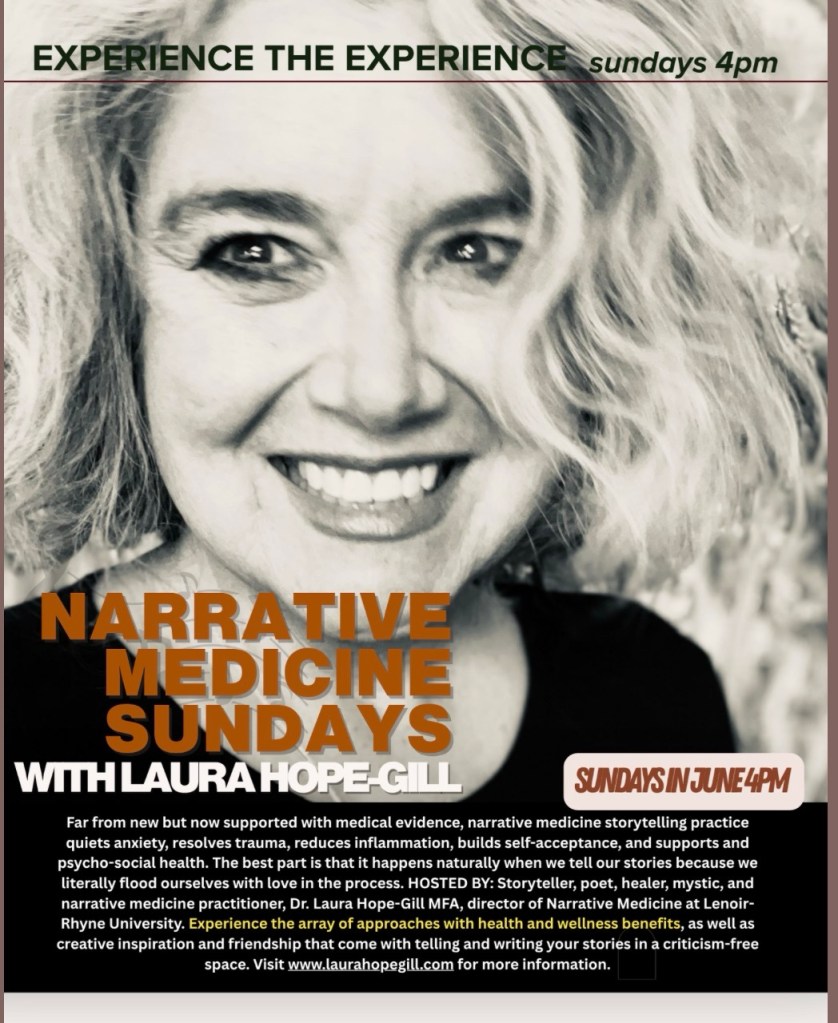
Dr. Laura Hope-Gill MFA

I am a Distinguished Professor of Narrative Medicine in the Narrative Healthcare Certificate Program at Lenoir-Rhyne University where I also teach in the MFA in Creative Writing Program. I teach clinical doctors, surgeons, counselors, and Health Sciences graduate students about this new, recognized field in clinical practice. I facilitate Narrative Medicine workshops within the medical community and beyond it.

I am a professional storyteller, an award-winning poet, memoirist, and historian. My forthcoming book, Bee Bread: How the Hive of Story Listening and Storytelling Heals the World, will be published in Fall of 2026. I come to Medicine from the side of the Storytellers and Creative Imagination, which is the worldview Enlightenment suppressed and has led us back to through Narrative Medicine. Stories heal in ways Science can’t explain but Story Lore can.

I have researched the creative process since 1990 because I have written poems and reflections since early childhood. I have15 years’ experience of teaching the research in narrative-based healing modalities and healing frameworks including:

Narrative Medicine

Appalachian Storytelling

Expressive Writing

Poetic Medicine

Poetry Therapy

Narrative Therapy

Depth Psychology

Classical and Contemporary Poetry

Folklore

Proprioceptive Writing

Journal Therapy

Bibliotherapy

As a practitioner of Narrative Medicine, I support and encourage individuals as they enter the world of words. For three centuries this world has been defined from the outside as Fine Art in Poetry, Fiction, and Philosophy, instead of revered as vital, archaic means of working the self and world. Modernity’s definitions serve to belittle and devalue inner life. More than one thousand published studies in narrative-based medicine call our attention to reconsider them. The research invites us to revisit the origin of our stories and our need to tell them. Cultural research leads us to acknowledge the role of Storytelling in every culture prior to the 1700s including in the West, and those who have succeeded in eveading it, not as decoration or something to do until humans invented the internet. Storytelling is central to our health, our well-being, our communities, and our survival. Zero exagerration. There is more to Story than the West has told.

Screenshot

I am a descendant of the Scots Chieftains of Clan MacLeod as well as, like all of us, a child of the world’s histories and migrations. Storytelling and Poetry were my ancestors’ (and yours) most prized treasure. The remain the doorway through which the seen and unseen aid one another. Fairy Lore for our ancestors is not trivial cute Disney stuff. It is the map to a perceptual field where matter and spirity conjoin. It tells us stories heal, words shape our worlds, and telling our stories maintains balance across the dimensions. My connection to the MacLeods grounds me in this “Clan of the Fairies” and restores me to the seat of a culture possessing an entirely different worldview from the one I was raised in.

Screenshot

For my Gaelic ancestors, Storytelling is the interface between the physical and spiritual worlds. It makes sense, therefore, that when I first saw the words “narrative medicine” in 2013, I immediately followed the call to bear witness to modern medicine’s realization that without Storytelling, its purview is pill-dispensing and procedures. Narrative Medicine addresses the root causes of the conditions such treatments address: trauma, anxiety, loneliness, and unprocessed rage and grief. We share these emotional paines, and we share access to the free, universal healthcare found in our stories.

Screenshot